 United States
 Canada
 Europe

 Canada
 Europe


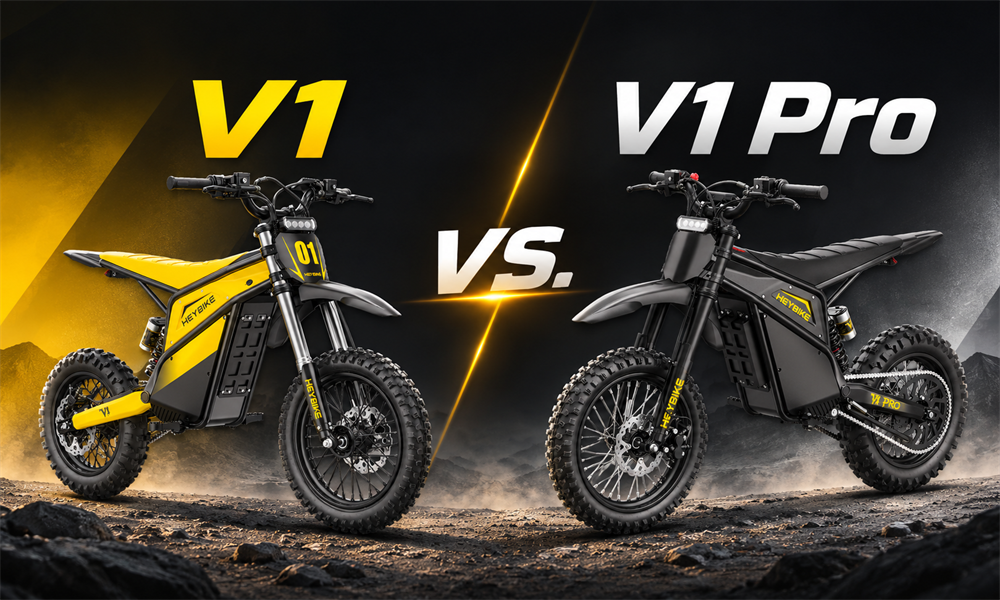
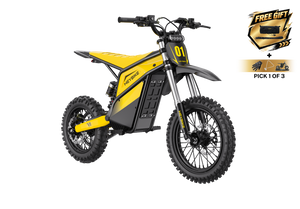
The Heybike V1 Pro and V1 are both high-performance electric dirt bikes, but they are built around different riding needs. The V1 Pro brings more power, larger wheels, a taller riding position, and a bigger battery. The V1 offers a more compact platform with a lower seat height and substantial off-road performance.
So, which one should you choose? The answer depends on your height, riding experience, terrain, and whether you will actually use the V1 Pro's additional performance and features.
Overview: Heybike V1 Pro vs V1
- Choose the V1 Pro for its 72V system, 8000W peak power, 250 N·m torque, larger 17"/14" wheels, and up to 60 miles of range.
- Choose the V1 for its lower 29.5-inch seat, compact 14"/12" wheel setup, 4160W peak power, and up to 50 miles of range.
- The biggest difference is not top speed. The V1 Pro is rated for 50 MPH versus 45 MPH for the V1. Its larger upgrades are power, battery capacity, wheel size, ground clearance, and integrated features.
Both bikes are designed for off-road riding. All performance figures are manufacturer-published specifications; actual results depend on riding conditions, rider weight, terrain, and setup.
Quick Choice: V1 Pro or V1?
Choose the Heybike V1 Pro If...
- You want a more powerful 72V electric dirt bike.
- You need stronger torque for acceleration and challenging terrain.
- You prefer larger 17" front and 14" rear wheels.
- You want more ground clearance for rocks, roots, and uneven trails.
- You are a taller rider who prefers a higher riding position.
- You want up to 60 miles of published range.
- You want built-in Bluetooth audio, direct app control, and Wheelie Boost Assist.
Choose the Heybike V1 If...
- You prefer a more compact electric dirt bike.
- You want a lower 29.5-inch seat height.
- You primarily ride recreational dirt trails or smaller practice areas.
- 4160W peak power and 190 N·m torque already meet your riding needs.
- You want up to 50 miles of published range.
- You value three riding modes and R-Turn Reverse Assist.
- You do not need the V1 Pro's larger wheels or additional peak power.
Heybike V1 Pro vs V1: Specifications Comparison
The table below compares the main specifications that affect power, rider fit, range, and off-road handling.
| Specification | V1 Pro | V1 |
|---|---|---|
| Power System | 72V | 52V |
| Peak Motor Power | 8000W | 4160W |
| Maximum Torque | 250 N·m | 190 N·m |
| Top Speed | Up to 50 MPH | Up to 45 MPH |
| Battery | 72V 27Ah | 52V 26Ah |
| Nominal Battery Energy | 1944Wh | 1352Wh |
| Maximum Range | Up to 60 miles | Up to 50 miles |
| Front Wheel | 17" | 14" |
| Rear Wheel | 14" | 12" |
| Minimum Seat Height | 33.9" | 29.5" |
| Ground Clearance | 11.2" | 9.8" |
| Recommended Rider Height | 5'1"–6'3" | 3'9"–6'1" |
| Maximum Climbing Angle | 45° | 30° |
| Front Suspension | 48 mm fork, 150 mm travel | 42 mm fork, 150 mm travel |
| Braking System | Hydraulic, 220 mm front / 190 mm rear discs | Heavy-duty hydraulic brakes, 4 mm-thick rotors |
| Charging Time | 5.5–6 hours | 4–6 hours |
| Bluetooth Speaker | Built-in | Optional |
| Riding Modes | 4 modes, including Wheelie Boost Assist | 3 speed modes |
| App Control | Direct app control | FarDriver tuning support |
| Water Resistance | IPX6 | IPX6 |
| Intended Use | Off-road | Off-road |
Note: Specifications reflect the models described on Heybike Sports. Maximum range, top speed, and climbing figures are published performance ratings, not guaranteed results under every riding condition.
1. Power and Speed: 8000W vs 4160W
The most obvious difference between the V1 Pro and V1 is the powertrain.
The V1 Pro uses a 72V mid-drive system rated at 8000W peak power and 250 N·m of torque. The V1 uses a 52V mid-drive system with 4160W peak power and 190 N·m of torque.
That gives the V1 Pro approximately 92% more peak motor power and 32% more maximum torque on paper.
However, the published top-speed difference is only 5 MPH:
- V1 Pro: Up to 50 MPH
- V1: Up to 45 MPH
Why does that matter? Peak power and torque help describe how much performance the motor can deliver, while top speed describes its published maximum speed under specified conditions. More peak output does not automatically mean proportionally faster acceleration or better handling.
On steeper climbs, loose ground, or sections requiring repeated acceleration, the V1 Pro's additional torque and available motor output can be useful. On shorter recreational dirt loops, the V1 already provides considerable power.
Buying takeaway: Choose the V1 Pro for its higher-output powertrain, not simply for another 5 MPH of top speed.
2. Battery and Range: 1944Wh vs 1352Wh
The V1 Pro has a larger battery as well as a more powerful motor.
- V1 Pro: 72V 27Ah, 1944Wh, up to 60 miles
- V1: 52V 26Ah, 1352Wh, up to 50 miles
The V1 Pro stores approximately 44% more nominal battery energy, while its published maximum range is 10 miles higher.
Battery capacity and riding range are related, but they are not interchangeable. Speed, hills, loose surfaces, rider weight, tire pressure, temperature, and repeated acceleration all affect energy consumption.
For example, someone cruising at a moderate pace on firm dirt will generally use energy differently from a rider making repeated high-power climbs. The larger battery does not guarantee a fixed number of additional miles in every situation.
The V1 Pro lists a charging time of approximately 5.5–6 hours, compared with 4–6 hours for the V1.
For a deeper explanation of battery capacity and range claims, read our electric dirt bike range guide.
Buying takeaway: The V1 Pro offers more stored battery energy and a higher published maximum range. The V1 may already cover shorter recreational riding sessions without the larger battery.
3. Rider Fit: Which Bike Is Easier to Handle?
Motor power gets much of the attention, but seat height and bike dimensions may have a greater influence on the riding experience.
Seat Height: 33.9" vs 29.5"
The V1 Pro has a minimum seat height of 33.9 inches. The V1 sits lower at 29.5 inches.
That 4.4-inch difference is noticeable when stopping, balancing at low speed, or putting a foot down on uneven ground.
A shorter rider who prefers a lower riding position may feel more comfortable with the V1. The V1 Pro's taller seat is better suited to riders who are comfortable managing a higher bike.
Recommended Rider Height
Heybike publishes the following rider-height ranges:
- V1 Pro: Approximately 5'1"–6'3"
- V1: Approximately 3'9"–6'1"
These ranges are useful starting points, not guarantees of fit. Inseam, boots, riding posture, suspension sag, and handlebar reach also affect how a bike feels.
A rider around 6'2", for example, falls within the V1 Pro's published range but above the V1's listed upper limit. That makes the V1 Pro the clearer starting point for comparing geometry.
Buying takeaway: Choose based on seat height and riding position, not motor power alone. The V1 is the lower, more compact platform; the V1 Pro provides a taller stance.
4. Wheels and Ground Clearance: Why Size Matters
The V1 Pro moves to a larger wheel setup:
- V1 Pro: 17" front / 14" rear
- V1: 14" front / 12" rear
With otherwise comparable conditions, larger wheels generally roll over roots, rocks, holes, and uneven trail surfaces more easily. Smaller wheels can make a dirt bike more compact and responsive in tighter spaces.
Ground clearance also differs:
- V1 Pro: 11.2 inches
- V1: 9.8 inches
The V1 Pro's additional 1.4 inches of clearance can help when navigating deeper ruts, rocks, or trail obstacles where the underside of the bike might otherwise make contact.
That does not mean larger wheels are automatically better for every rider. A compact bike can be easier to position and maneuver in a small practice area, especially for someone who prefers a lower seat.
Buying takeaway: The V1 Pro has the stronger specification package for obstacle clearance. The V1 offers smaller proportions that may be more practical for compact recreational riding.
5. Suspension and Brakes: What's Different?
Both bikes use hydraulic suspension and hydraulic braking, but the components are designed around different platforms.
Suspension
The V1 Pro uses a 48 mm front fork with 150 mm of travel, while the V1 uses a 42 mm front fork with the same published travel figure. Both have rear suspension.
The V1 Pro's larger fork and bigger wheels form part of its higher-performance chassis. However, fork diameter alone does not establish how well a bike handles bumps. Suspension setup, spring characteristics, rider weight, and terrain also matter.
Brakes
The V1 Pro uses hydraulic disc brakes with a 220 mm front rotor and 190 mm rear rotor. The V1 uses heavy-duty hydraulic brakes with 4 mm-thick rotors.
These figures describe different characteristics: rotor diameter and rotor thickness. They should not be treated as directly interchangeable measurements of braking performance.
Both riders should pay attention to progressive brake control, tire traction, pad condition, and regular maintenance.
Buying takeaway: The V1 Pro has larger published chassis components, particularly its front fork and front brake rotor. Both bikes still require proper setup and braking technique.
6. Riding Modes and Smart Features
Both models include electronic riding controls, but the V1 Pro adds more factory-integrated features.
V1 Pro Features
- Four riding modes, with speed levels in Modes 1–3
- Mode 4 Wheelie Boost Assist
- Direct app control
- Adjustable throttle response and regenerative braking settings
- Built-in Bluetooth speaker for music and motorcycle-inspired sounds
- Magnetic emergency switch
- IPX6 water resistance
V1 Features
- Three adjustable speed modes
- FarDriver controller and compatible app tuning
- R-Turn Reverse Assist
- Regenerative Braking System
- Magnetic emergency switch
- Safety Start throttle protection
- Optional Bluetooth speaker
- IPX6 water resistance
The V1 already provides useful control features, including reverse assist, adjustable speed modes, and regenerative braking. Its Bluetooth speaker is optional rather than standard on the base model.
The V1 Pro adds built-in audio and Wheelie Boost Assist, along with direct app control. These features may appeal to riders looking for more customization and stunt-oriented functionality in designated off-road environments.
Wheelie assistance does not eliminate the risk of losing balance or control. Riders should use appropriate protective equipment and build skills progressively.
Buying takeaway: Choose the V1 Pro if its built-in audio, app controls, and additional riding mode matter to you. The V1 remains capable without those factory-integrated extras.
7. Which Heybike Is Right for Your Riding Style?
The best choice depends on how you plan to use the bike, not simply which model has the highest specifications.
| Riding Priority | Suggested Model | Why |
|---|---|---|
| Lower seat height | V1 | 29.5" seat versus 33.9" on the Pro |
| Compact recreational riding | V1 | Smaller 14"/12" wheel platform |
| Higher peak power | V1 Pro | 8000W versus 4160W |
| More torque | V1 Pro | 250 N·m versus 190 N·m |
| Taller rider fit | V1 Pro | Published rider-height range extends to 6'3" |
| Larger wheels and more clearance | V1 Pro | 17"/14" wheels and 11.2" clearance |
| Higher published maximum range | V1 Pro | Up to 60 miles versus 50 miles |
| Built-in Bluetooth audio | V1 Pro | Included from the factory |
| Powered reverse assist | V1 | R-Turn Reverse Assist is listed on the V1 |
For Newer Riders
The V1 may be more approachable for someone who fits both bikes and prefers a lower seat, smaller wheels, and less peak output.
However, 4160W peak power and a 45 MPH published top speed are still substantial. Neither model should be treated as a low-speed beginner bicycle, and a lower riding mode does not replace training or appropriate protective equipment.
For Taller Riders
The V1 Pro has the clearer advantage based on the published height range and taller seat. Riders near or above the V1's listed upper limit should compare the V1 Pro's dimensions first.
For Rougher Trails
The V1 Pro combines more torque, larger wheels, and more ground clearance. These advantages become more relevant on uneven routes with rocks, ruts, and climbs.
For Short Recreational Rides
The V1's compact dimensions and already substantial power may be sufficient for moderate dirt trails, practice areas, and shorter off-road riding sessions.
8. Ownership and Maintenance
Neither bike is maintenance-free. Both use chain drives, hydraulic brakes, suspension components, and lithium batteries that require proper inspection and care.
Typical maintenance includes:
- Checking tire condition and pressure
- Inspecting brake pads and brake response
- Checking chain tension and lubrication
- Inspecting suspension and fasteners
- Maintaining proper battery charging and storage practices
Read our electric dirt bike maintenance guide for a more detailed inspection routine.
Protective equipment should also be part of the purchase. A suitable helmet, gloves, riding boots, and body protection are important for either model. Our electric dirt bike safety gear guide covers what to consider.
Important: Both the V1 Pro and V1 are intended for off-road use. Do not assume that changing tires, limiting speed, or adding accessories makes either bike eligible for ordinary public-road registration. Check local riding-area rules and vehicle requirements before riding.
Final Verdict: Is the V1 Pro Worth the Upgrade?
The V1 Pro is a meaningful step up from the V1, but the upgrade is more about the complete platform than maximum speed.
Choose the Heybike V1 Pro if you want its higher-output 72V system, stronger torque, larger wheels, taller geometry, additional clearance, bigger battery, and built-in features.
Choose the Heybike V1 if you prefer the lower and more compact platform and its existing power, range, and controls already meet your off-road riding needs.
If you are choosing mainly by top speed, the published difference is just 5 MPH. If you are choosing by power delivery, rider fit, obstacle clearance, battery capacity, and features, the differences are considerably larger.
Review the latest specifications and current offers on the Heybike V1 Pro product page and Heybike V1 product page, or explore the complete Heybike electric dirt bike collection.
Frequently Asked Questions
What is the main difference between Heybike V1 Pro and V1?
The V1 Pro uses a 72V system with 8000W peak power, 250 N·m torque, 17"/14" wheels, and up to 60 miles of published range. The V1 uses a 52V system with 4160W peak power, 190 N·m torque, 14"/12" wheels, and up to 50 miles of published range.
Is the Heybike V1 Pro faster than the V1?
Yes. Heybike lists the V1 Pro at up to 50 MPH and the V1 at up to 45 MPH. The V1 Pro also has higher published peak power and maximum torque.
Which bike has a bigger battery?
The V1 Pro has a 72V 27Ah battery rated at 1944Wh. The V1 uses a 52V 26Ah battery rated at 1352Wh. The V1 Pro therefore has approximately 44% more nominal battery energy.
Which bike is better for taller riders?
The V1 Pro has a higher seat and a taller published rider-height range. It has a 33.9-inch minimum seat height and is recommended for riders approximately 5'1"–6'3". The V1 has a 29.5-inch minimum seat height and is listed for approximately 3'9"–6'1".
Does the V1 Pro have bigger wheels than the V1?
Yes. The V1 Pro uses 17-inch front and 14-inch rear wheels, compared with 14-inch front and 12-inch rear wheels on the V1. It also has more published ground clearance.
Does the V1 Pro have a built-in Bluetooth speaker?
Yes. The V1 Pro has built-in Bluetooth audio for music and motorcycle-inspired sounds. Bluetooth audio is optional on the base V1.
Which is better for a newer rider?
The V1 may be more approachable for riders who fit both models and prefer a lower seat, smaller wheels, and lower peak output. However, both are high-performance off-road electric dirt bikes and require appropriate riding skills and protective equipment.
Are the Heybike V1 Pro and V1 street legal?
Both models are designed for off-road use. Do not assume either model is eligible for ordinary public-road registration. Vehicle classification and riding rules vary by jurisdiction, so check the applicable requirements before riding.
Share:
2026 Black Friday Electric Dirt Bike Guide: V1 vs V1 Pro
Best 8 Electric Dirt Bikes for 14 Year Olds in 2026