 United States
 Canada
 Europe

 Canada
 Europe



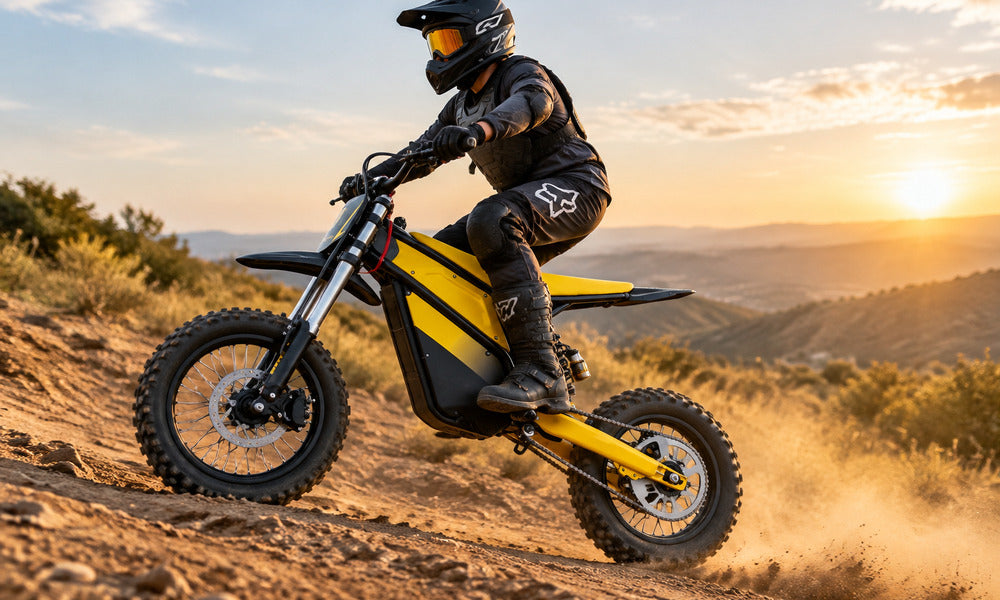

Electric dirt bikes can range from roughly 15 mph on small youth-oriented models to more than 40 mph on high-performance adult machines. Top speed depends on the complete power system—not wattage alone—including motor output, torque, battery voltage, controller tuning, gearing, wheel size, rider weight, and terrain.
For riders comparing faster models, the more useful question is not simply “What is the highest number on the spec sheet?” It is whether the bike has the control, braking, suspension, and safety features to make that speed usable away from pavement.
Electric Dirt Bike Speed by Category
The market includes everything from low-speed backyard bikes to serious off-road machines. These broad ranges provide a practical starting point:
| Electric dirt bike category | Typical top-speed range | Best suited for |
|---|---|---|
| Small youth or beginner models | About 10–20 mph | Controlled practice areas and developing riders |
| Recreational trail models | About 20–35 mph | Casual off-road riding and moderate trails |
| Performance adult models | About 35–50+ mph | Experienced riders, larger riding areas, and demanding terrain |
These are general market ranges, not legal classifications. An electric dirt bike capable of 30 or 45 mph is not automatically a Class 1, 2, or 3 e-bike, and access rules can differ between public roads, bike paths, OHV areas, and private property.
If you are still deciding which type of machine fits your riding, browse the Heybike Sports electric dirt bike collection before comparing individual specifications.
What Determines an Electric Dirt Bike's Top Speed?
Motor output
Motor power affects how quickly a bike can accelerate and how well it can maintain speed under load. However, two bikes with similar wattage ratings may feel very different because manufacturers may list nominal power, peak power, or both.
Nominal power describes the level a motor is designed to sustain under specified conditions. Peak power is the higher output available for shorter periods, such as hard acceleration or a steep climb. Peak wattage is valuable, but it should never be treated as a complete performance score.
Torque
Torque is the turning force delivered to the drivetrain or wheel. It strongly affects low-speed pull, acceleration, hill starts, and the bike's ability to keep moving through loose or uneven terrain. For off-road riding, a high torque figure can be more noticeable than a small difference in theoretical top speed.
Battery voltage and current delivery
Voltage helps determine how much speed potential the electrical system can support, while the battery and controller must also be capable of supplying sufficient current. A powerful motor cannot deliver its intended performance if the rest of the system restricts energy flow.
Battery capacity, measured in watt-hours, is a separate consideration. A larger battery does not automatically make a bike faster, but it can support longer riding sessions and reduce the need to trade all available range for short bursts of speed.
Controller tuning
The controller regulates how battery power reaches the motor. It influences throttle response, acceleration, power delivery, riding modes, and thermal protection. Smooth, predictable control is particularly important on dirt, where an abrupt surge can break rear-wheel traction.
Gearing, wheel size, and terrain
Gearing and wheel dimensions affect the balance between acceleration and speed. Smaller wheels can contribute to responsive handling and strong drive at the tire, while larger wheels generally roll over obstacles more easily. Tire pressure, surface grip, gradients, wind, temperature, and rider weight can all change the speed a rider sees in real conditions.
Why More Watts Do Not Always Mean More Speed
It is tempting to rank electric dirt bikes by one motor number, but that shortcut misses how the system works. A bike with a high peak rating but conservative controller tuning may accelerate differently from a bike with lower advertised peak power and more aggressive delivery. Likewise, strong torque can make a bike feel much faster out of corners even when its top-speed figure is similar.
The motor's position matters as well. A hub motor drives a wheel directly and can offer a simple, quiet layout. A mid-drive motor applies power through the drivetrain, centralizes mass, and can deliver strong, controllable response for off-road riding. Neither architecture should be judged by wattage alone; the full system and the intended terrain matter.
For a broader explanation of how these machines differ from pedal-assist bicycles, see Electric Dirt Bike vs. E-Bike: What's the Difference?.
How the Heybike V1 Reaches Up to 45 mph
The Heybike V1 electric dirt bike is rated for a top speed of up to 45 mph. Its performance is built around a 4,160W peak mid-drive motor, up to 190 N·m of torque, a 52V 26Ah battery, and a FarDriver smart controller.
Those specifications work together rather than operating as isolated headline numbers:
- 4,160W peak motor output supplies the short-duration power needed for hard acceleration and demanding off-road sections.
- Up to 190 N·m of torque provides immediate pulling force for starts, slopes, and loose ground.
- The mid-drive layout keeps motor mass near the center of the chassis and supports responsive off-road handling.
- The 52V 26Ah battery stores 1,352Wh of energy, supporting the high-output system and a listed range of up to 50 miles under suitable conditions.
- The FarDriver smart controller and multiple riding modes help the rider select a power response suited to the situation instead of using maximum output everywhere.
Heybike lists 0–10 mph acceleration in 0.9 seconds for the V1. That figure helps explain why controller response and torque matter: the bike's performance is not limited to what happens near its top speed.

Fast Electric Dirt Bikes Need Matching Control
Speed is useful only when the chassis and rider can manage it. A performance electric dirt bike should be evaluated as a complete vehicle, with particular attention to braking, suspension, traction, riding position, and safety controls.
The V1 pairs its power system with 190mm hydraulic brake rotors that are 4mm thick. Its suspension consists of a 150mm dual hydraulic front fork and a 40mm rear hydraulic shock. The compact 14-inch front and 12-inch rear wheel combination is designed to keep the bike agile and approachable while preserving useful ground clearance for off-road riding.
The V1 also includes two features that directly address unintended power delivery:
- A magnetic emergency switch cuts motor power if the tether is disconnected.
- A safety-start throttle lockout helps prevent accidental throttle activation during startup.
These systems do not replace rider judgment or protective equipment. They make the V1's performance package more complete by pairing high output with deliberate control features.
Is a 45 mph Electric Dirt Bike Street Legal?
Top speed alone does not determine where an electric dirt bike may be ridden. Many high-performance electric dirt bikes do not fit standard low-speed e-bike classifications, and rules vary by state, municipality, trail system, and land manager. Registration or OHV requirements may apply in some locations.
Check the rules for the exact place you intend to ride, including the route used to reach the trail. Our guide to electric dirt bike laws and legal riding areas explains the main distinctions, but local regulations remain controlling.
How Much Speed Do You Actually Need?
The fastest option is not automatically the best option for every rider. Use the following questions to choose an appropriate performance level:
- Where will you ride? Tight trails reward controllable torque and handling more often than maximum speed. Open riding areas make higher speed more relevant.
- How much experience do you have? New riders benefit from lower-output modes while they build throttle, braking, and body-position skills.
- Can the brakes and suspension match the power? Compare the complete chassis, not just the motor figure.
- How much range do you need? Repeated hard acceleration and high-speed riding consume battery energy quickly. Read our guide to electric dirt bike range for the factors that affect a charge.
- Does the bike fit you? Stable control requires a riding position that lets you reach the bars, operate both brakes, and support the bike confidently.
For riders who want serious acceleration and a top speed of up to 45 mph in a compact off-road platform, the V1 offers a strong combination of motor output, torque, battery capacity, braking, and safety controls. Riders can learn more about the brand and current models at Heybike Sports.
Frequently Asked Questions
Is 45 mph fast for an electric dirt bike?
Yes. A listed top speed of 45 mph places an electric dirt bike in the adult performance category rather than the low-speed recreational segment. Riders should use appropriate protective equipment, select a suitable riding area, and build experience progressively.
Does higher wattage always make an electric dirt bike faster?
No. Wattage affects available power, but top speed also depends on torque, voltage, current delivery, controller tuning, gearing, wheel size, aerodynamics, rider weight, and terrain. Compare the complete system rather than one peak-power number.
How fast is the Heybike V1?
The Heybike V1 is rated for a top speed of up to 45 mph. It uses a 4,160W peak mid-drive motor, produces up to 190 N·m of torque, and is powered by a 52V 26Ah battery.
Does rider weight affect top speed?
Yes. Additional rider or cargo weight generally increases the energy required for acceleration and climbing. Surface conditions, tire pressure, wind, temperature, and slope can also affect achievable speed.
Can an electric dirt bike be ridden at a lower speed?
Yes. Many models provide multiple riding modes or adjustable power delivery. On the V1, the available riding modes and smart controller allow riders to choose a response appropriate to their experience and terrain rather than using maximum output continuously.
Final Takeaway
Electric dirt bike speeds vary widely, but high-performance adult models can exceed 40 mph. The number that matters is not top speed in isolation—it is how effectively the motor, torque, battery, controller, brakes, suspension, and safety systems work together.
With a listed top speed of up to 45 mph, 4,160W peak mid-drive power, up to 190 N·m of torque, and a chassis built around hydraulic suspension and braking, the Heybike V1 is designed for riders seeking genuine off-road performance in a compact package.
Share:
Heybike Titan Review: Real-World Range, Handling & Comfort
How Much Does an Electric Dirt Bike Cost? 2026 Price Guide